Wednesday, November 7, 2012

Between the Lines


Lines can be a pictorial element, lines can form patterns and shapes, lines can lead your eyes to specific subject, and lines can help you frame your subject.  Lines are to be read leading and transforming complexity to simple composition.  Hence it takes a really good eye to read between the lines. 

Lines are the architecture of the Holocaust Memorial - lines are everywhere. There are the long horizontal lines of names, all the victims lost. These lines are the background to the human figures sculpted at the heart of the memorial. Everywhere you look, behind and through the bronze figures, the names of the dead fill in your view.


The last name in the list is Zusha Mamber, and whild that line stops abruptly, the story isn't finished.  The memorial leaves plenty of blank black granite where more names can be added at families' request.                                                                                               


A trip through the entire memorial takes you around in a circle, but straight lines in its design keep visitors moving in the right direction. Diagonal lines of stone point toward the giant hand and the tortured figures climbing up its arm at the heart of the memorial. Narrow shafts of light shift throughout the day in the tunnel that leads to that hand. These lines do more than guide visitors, they pull them toward the memorial's center of grief.


JKay


Wednesday, October 17, 2012

iPhone Vs Camera


The previous blog set the stage: One vacation, many cameras. I shot most everything twice, trying to line up the composition so that the only real difference was the focal length - one I could control with an SLR or DSLR, or one that I could not control with the iPhone 4. With the camera phone, I tried to keep the filter consistent and subtle so that the images were not overly distorted. I wanted the iPhone images to capture the same element I sought with the "real" cameras - the way the soft, warm light of late August, even on overcast days, enhanced the textures of water, faces and wood.


Sometimes, the iphone gave me a perspective that I didn't realize I had when I looked through the "real" camera's viewfinder - it really gave me height, the ability to focus while holding the phone above my head. The extra room around my mother standing in front of her classroom blackboard, for example, gives you more information about her classroom than the saturated colors picked up by my DSLR. However, the lack of a filter on the DSLR led to more saturated colors - the colors of summer that I was trying to convey - such as the green grass stains on my mother's white tennis shoes as she mowed the lawn.


I added my digital point-and-shoot, with all it's shooting options and zoom capabilities, to the mix? What else would have been revealed about the subjects? Or does the filtering options on the iPhone inherently add an interesting element unattainable with a "real" point-and-shoot camera? That's the exercise I have planned for my next trip.I found both camera options to be valuable tools and successful in their own ways. Now I'm curious: What if I had added my digital point-and-shoot with all its shooting options and zoom capabilities into the mix? What else would have been revealed about the subjects?  Or do the filtering options on the iPhone inherently add an interesting element unattainable with a "real" point-and-shoot camera?


Tuesday, October 9, 2012

Urban Safari

 
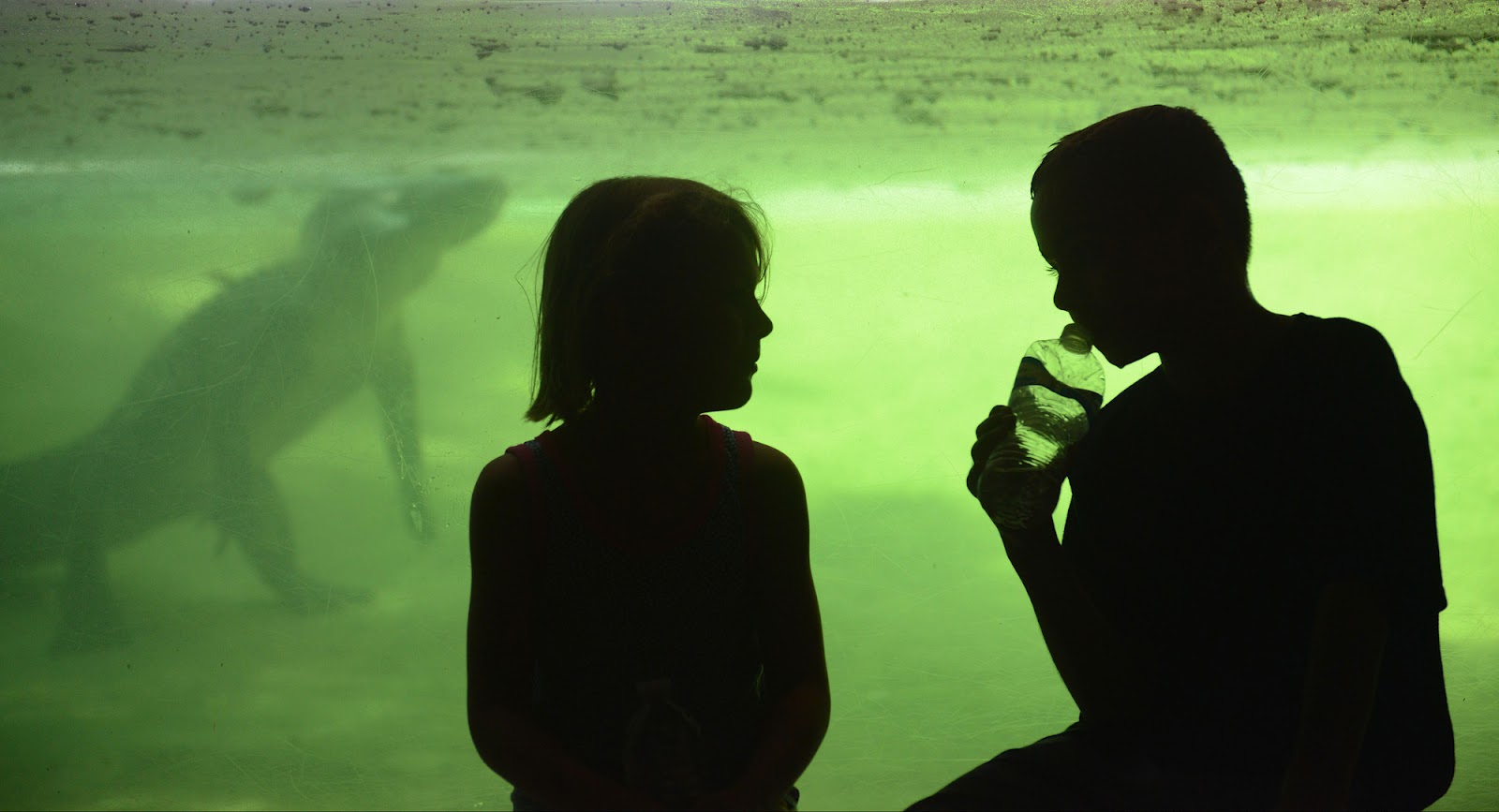
Strolling Jungle Island can be a great opportunity to practice photography as there are a wide variety of subjects to challenge one's creativity and technical skills. Particularly, when you get to go with your photography professor and three very energetic kids running ahead of you!


It is a great location to practice how to overcome certain challenges. For me, the major issues were the distance to the animals and shooting through glass or bars. In these situations, sometimes tightly cropping to an animal's face, or body, helps getting a shot with real impact.


Moving subjects can also be challenging as rarely do these animals stay still, although I did stumble upon one or two animals in the perfect pose.

Patience is a must and for the most part one has to stick around and wait for something interesting to happen. And, of course, there is always the changing light and trying to find a good angle of view. 


Since I now have an annual pass, I will most certainly go back soon and try again with different exposures and lenses. As with all things, practice makes perfect!


Monday, October 1, 2012

THREE CAMERAS


I was visiting familiar landscapes in the suburbs of Philadelphia, and I wanted to capture in photographs the light and textures that I associate with the end of the summer. In my head, I know how the late August light casts everything in a soft, warm light. The cool relief of dark shadows and swimming pools. The dry blades of grass that still somehow retain their saturated colors.

I wanted to communicate those sensations recorded by the camera in my head, but I didn’t know which camera in my hands would get it right. So, I shot most of my subjects twice, often standing in the same spot and keeping the frames as similar as possible. The only significant difference between the frames was the focal length: I had no control over the standard iPhone camera lens, while with my Nikon I tended to shoot with either a 50mm or 20 mm lens set with a wide aperture.

Can you tell which camera was used for each frame? Which frames do you prefer, the iPhone images or the “real” camera frames -- and why?  The answers and my picks will be revealed in a future blog post.


Saturday, September 29, 2012

One Frame a Day

IPC Visual Lab has extend the invitation to its students to produce one picture a day
for the next consecutive 70 days.  We are also extending this challenge to the public,
as part as of a photo competition where the winner wins free classes in Spring 2013
and also gets to be part of Iris PhotoCollective's exhibition in the fall.  If you think you have
the skills then please let us know at ipcvisuallab@gmail.com.  Each image must be
produced in the vein of photojournalism.  No digital manipulation or photoshop trickery,
and definitely no setups.   All images must be by a single photographer with cutlines
and other meta data information.  Good luck, now let see what IPC Visual Lab student,
Zeus Shama, has submitted.


Hard to Enjoy: Day 1 
September 22, 2012
This photo breaks my heart and is hard to share.  This is my wife and son sitting on a stone wall down in Key Largo, Florida.  We drove down on a Sunday morning in September to get away from the stress of my current jobless situation but it proved to be more difficult than anticipated.

                                                                                                                                                                                                                                
No Kids to Play With: Day 2
September 23, 2012
This image is part of the "Down Turn" series  that was shot within a two block radius of my home in Cutler Bay neighborhood of my home in Miami, Florida.  It is late September, the end of Hurricane season, and this backyard has no children as the family that lived in this home abandoned it due to being "upside down on their mortgage".  Families are fleeing their homes not because of natural disasters but man-made ones.


Barren Landscape: Day 3
September 24, 2012
This is an image is also part of the "Down Turn" series that was shot within blocks of my home in Cutler Bay neighborhood of Miami, Florida.  It is  late September, the end of Hurricane season, this is prime plot of land that was scheduled to start construction for a Mall.  But due to the economic downturn in the economy, the project has been abandoned indefinitely.

ZShama


Wednesday, September 26, 2012

Vacation Experiment


After spending a week in Paris, France I was looking over old photographer books owned by my grandfather.  My grandfather, Bernard, 80, was a paratrooper for the French Special Forces in Algerian War from 1957 to 1958 (Algerian War was a conflict between France and Algerian independence movement from 1954 to 1962, which led to Algeria gaining its independence from France  - source Wikipedia).  He rarely talks about his wartime adventures and when it is brought up he quickly changed the conversation.  He never showed me any photos of battle just training images.  When pressed, he would pick-up one of many photo books and precede to look at ones with animals.

As a mental refuge from wartime memories, Grandfather would share his photo books on animals.
Never talking (very awkward) he would just look at the pages while turning them at his own pace.

After receiving his first digital camera, Grandfather started documenting his daily life one frame at time and storing them on his computer.  Grandfather for some particular reason would concentrate on two distinctive geese that lived near his farm house.  From that point on, Grandfather would  continue photographing animals in pairs documenting the lives of his animal subjects.

Inspired by his love of animal photography, I wanted to get out of my comfort zone and emulate his photographic style and ventured out to a local horse stable. The perfect opportunity presented itself when my cousin, Antoine, invited me to attend his horse riding class and visit the stable where he kept his horse.

As I arrived, I noticed a rider briskly riding a horse.  I wanted to capture movement as the student
practiced trotting.   Due to lack of light, I first changed my ISO and proceed by lowering my shutter speed to 1/25 so that I capture the  motion blur to create the sense of movement.

After the trotting session and during the cool down stage of classes, Antoine approached his girlfriend and started
a conversation regarding an upcoming competition event.  During the exchange of words,
I noticed "V" created by Antoine's body, the horse, and its rider.  Quickly, I made a frame
slightly tilting the camera in order to get the parts of the saddle. 

As a avid sport shooter, I am use to shooting action. Grandfather taught me the art of slowing down.  To be more observant and finding other ways to express myself other than using words.  

How do you slow down? Share with me your thoughts and pictures that has caused you to stop and ponder.

EBitton


Monday, September 24, 2012

Deering Estate

The Deering Estate at Cutler is a 444-acre preserve at the edge of Biscayne Bay south of Miami. It was the winter home of the Deering family for 70 years before the property and its historic buildings were acquired by the state and Miami-Dade County in the mid-1980s. Now open to tours and nature walks, the estate offered an opportunity to try shooting two subjects I don't often seek out: interiors and nature.

The Beaux Arts home that Charles Deering built in the early 20th century has remained largely unchanged since his death in 1927. Largely empty of furniture, the ballroom and other interior spaces all incorporate natural elements in some way. The ceilings of the ballroom and exterior passageways incorporate shells and ocean imagery, while humidity bends the light from electric lamps. Lush views of palms and pine-rockland habitat through upstairs windows fill rooms now empty of anything except artwork on the walls.


An 18mm-55mm lens gave me a wider perspective than I do with the 50mm prime lens I normally use, allowing me to capture some of the vistas unique to the estate -- specifically the water and the imperiled pine-rockland and tropical hardwood hammock, accessible only from specific paths.  

Golden orb spiders, suspended in a large web, guarded the entrance to one nature trail. They're not poisonous, but they're intimidating; the large one was roughly  the size of my palm. 

JKay